I've spent the past week looking forward to punching the new 3.3 pound Premium trials frame right where its balls would be if it had any. Are we not men? Jesus fucking hopped-up Christ. Is doing tailwhips that important now? Does everyone have to be able to do them within six months of learning to pedal? Isn't the fun of riding in the journey, not the destination? If a four-pound frame is too heavy, maybe take up a less-strenuous activity, like hairdressing or Sudoku. This is all going to end badly. I can feel it.
But honestly, I think I just needed the break. Furthermore, I'm gonna take a few more days as well. This is not the end—heck, maybe I'll be back tomorrow—but I want to take a little time to re-group. Maybe I'll be re-energized by some of the dumb stuff that starts leaking out before Interbike (which I will not be attending for a record-breaking 37th straight year). In fact, I'm sure I will be. Right now I just don't have all that much to say.
A heartfelt thanks to all who read and comment on the regular, you're the ones who make SPRFLS, well, not entirely superfluous.
If Whole Foods sold BMX bikes, they'd definitely sell the Svevo Bespoke (recently named the best BMX bike at Eurobike 08):
And all along I thought "Svevo" was an Ikea bookshelf. Here's what they say about it on their website:
"The Svevo Bespoke represents the new generation of street bmx bikes. Ultralight (9,0 kg), brakeless and pegless. For riders who love the flow. No compromises. Svevo frames are designed with simplicity and lightness in mind. The carefully selected bmx specific tubing is filletbrazed by hand in Germany. The extra thickness of the fillet provides strength, and its smooth contour distributes stresses evenly. No external gussets are needed. With the integrated pivotal seatpost this creates a perfectly clean look. Modern graphics add extra style.
Svevo customers can specify the geometry, the color, and the components to create their dream bike."
Wonderful. I'm surprised that they don't point out that it's organic and fat-free, too. (As shown, it weighs 19.5 pounds complete.) Apparently the "new generation of street bmx bikes" are going to be really light, really stylish and really fucking expensive. And sprinkled liberally with titanium and bullshit. "Modern graphics add extra style?" All in all, this doesn't give me much hope for the new generation of street bmxers. Alex Liiv, beware.
(I wonder how far the "dream bike" thing can be taken? What if I want a 23" toptube, 79 degree headtube, 64 degree seattube, an American bottom bracket and the ability to run a regular seatpost AND a seatpost clamp? Or a brazed STA replica complete with gusset? I suppose I could e-mail and find out, but I guess I'm not that interested.)
It's worth noting that fillet brazing is a time-tested method of frame construction that utilizes a metal such as brass to join tubes. Since brass has a lower melting point than steel, the strength of the steel tubing is never compromised—and you can use thinner-gauge tubing as a result. At least that's how I read it. Schwinn used it on some road frames from 1938 to 1978, nowadays it's a technique that's primarily used by boutique framebuilders. It's more or less obsolete for mass-produced bikes since it's labor intensive and the art of welding has improved greatly over the years. A bit of an odd way to build a "street" BMX frame, if you believe what's said here. Since we seem intent on going backwards, epoxied lugs can't be far behind. Ahead. Whatever. I'll be curious to see how Svevos hold up to actual street riding, provided anyone I know buys one. Because I gotta imagine they're gonna be expensive.
But I guess it's an image that Svevo is cultivating: Luxury customs. A bit silly for a product meant to be smashed into rails and ditched between doubles, but whatever. You know what bespoke means, right? It's a word normally associated with $300,000 cars and $8,000 suits and $2,500 pairs of shoes. It's a word for people who are above the banality of buying something that's already been produced. How trite. How utterly common. It's nothing I thought I'd see with BMX bikes.
Although I suppose in a world where you can throw down absurd sums of money for personalized Nikes or custom jeans, I should have seen this coming. Sure you can get something just as good off the rack, but what fun is that? This way you can be unique—just like everybody else.
Now if you'll excuse me, I have to measure my inseam.
Not sure whether you heard, but Eurobike or whatever the heck it's called happened recently. New products galore. Basically it's kind of like Interbike, just with more Europeans. Or, given the weakness of the dollar, maybe just fewer Americans. Certainly fewer Wayne Newtons.
Anyway, you can check out a bunch of product photos here (via Pijin) and read about them if you sprechen Deutsch. If you don't feel like clicking, here's a few highlights with my usual kneejerk (emphasis on jerk) opinions:
1. KHE Astral hubs.
We're just getting closer and closer to BMX parts being sold in baggies and priced by the gram, aren't we? I can't believe I ridiculed Alienation for listing their stuff by "street value." It's really happening! Anyway, another "you can only lace it the way we want you to" straight-pull front hub, and a bizarre Frankenstein cassette that looks like it should have rough stitches separating the left side from the right. I assume 452 grams is light for a pair of hubs—I'm glad I don't know how light. (Also, either that front hub has a REALLY long axle, or it's just happy to see me.)
2. Éclat brake
I don't know about the brake, but that scale is freaking awesome. You can weigh your coke on it, then cut and snort it right off the same surface! A mirrored scale! Man, I really want one. It's gotta be Japanese, right? Only they would come up with something so cool. Or Swiss. Maybe it's Swiss. Wait, what were we talking about?
3. Illegal BB Let's face it—if you don't have a super-trick, machined-out tube spacer in your bottom bracket, you should probably just sell your bike and take up knitting. Then again, who's gonna buy a bike that doesn't have a super-trick, machined-out tube spacer in the bottom bracket? Man, you're fucked.
4. KHE Hindenburg Titanium cranks
I realize that KHE's cranks have been named Hindenburgs for a long time. That said, naming a super-expensive, super-lightweight part after an airship that blew up spectacularly (killing 36 people in the process) seems like it's inviting, um, disaster. I can't wait until they release the super-slim Auschwitz Bars.
Wow, where do I sign up? *By today's exchange rate.
5. NC-17 magnesium pedals.
Come on you fuckin' jerks, you couldn't get 'em down to 290 even? Seriously? Couldn't you take out four pins, or shave the ends down a little bit more? What the fuck is wrong with you fucks? Were you even trying? We're NC-fuckin'-17, not PG-13. You're all fuckin' pathetic and you're all fuckin' fired.
Oh wait, there was a fly on the scale. Good job everyone!
6. Wellgo plastic pedals
Light, cheap, good-looking. Pick two. The first two. (Incidentally, putting a plastic pedal on a scale seems particularly stupid. I mean, it's a plastic pedal. Unless the spindle is made out of lead, how heavy can a plastic pedal be?) Don't they look like the same shitty plastic pedals that have come on $120 completes since the beginning of time. Well, since the '80s at least.
Time to re-visit the Subrosa Bash bike. I wanted to get into more detail today, only Sher never wrote me back. Ron Bonner did—to say that Sher had gotten my e-mail and to never hesitate to e-mail either of them with questions—but that's it. At least Subrosa ran a better photo of the bike (and some of the thoughts behind it) on their site. I'll post another update if/when I hear back from Ryan. I'm curious to know some things that aren't revealed on the site—like the price, availability and any sort of specs.
But for now, let's get into a little history, shall we?
Like I mentioned before, the Subrosa's bashguard is just a scaled-down version of the old Bully design, as seen below:
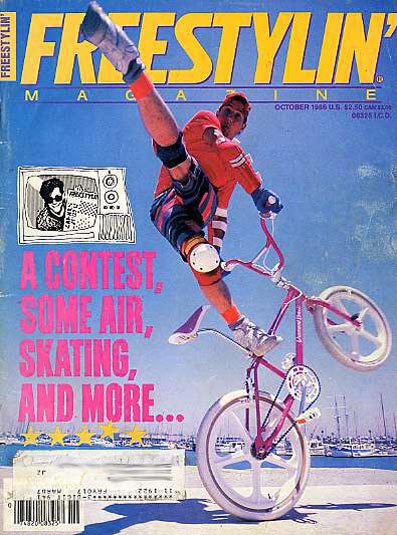
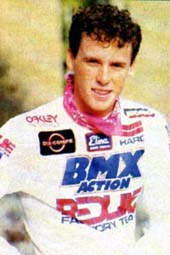
So let's talk about Bully. It's kind of an odd frame—and an odd company—to pay homage to. R.L. Osborn, who started Bully, was one of the most well-known freestylers in the '80s, thanks to his dad—BMX media mogul Bob Osborn, the founder of BMX Action and the owner of Wizard Publications (later responsible for Freestylin' and Go). R.L. was not only a member of the BMX Action Trick Team, he also got quite a few covers over the years. It's possible that his last name may have had something to do with this. Later on he entered contests, but it was obvious the future belonged to up-and-comers like Rick Moliterno, Kevin Jones and Dennis McCoy.
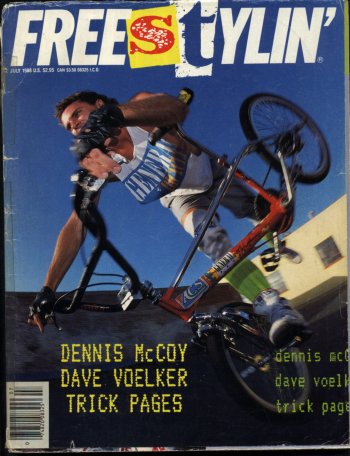
Then in the late '80s, everything changed. Street riding happened. All of a sudden uniforms weren't cool, contest runs were secondary to the riding that went on outside the venues, and meticulously color-matched neon bikes were out. Born showmen like Martin Aparijo and Woody Itson went the way of the bolt-on standing platform. Others survived: Pete Augustin, once a flatlander for CW and Schwinn, was reborn as "The Disgustman," a ripped, tattooed, neighborhood-terrorizing skinhead. Dave Voelker showed he could shred just as hard on the streets as he could on a halfpipe. A crew of grimy San Diego misfits started calling themselves the Dirt Brothers. And then there was R.L.
R.L. was one of those guys on the fast road to irrelevancy. He'd spent his career wearing uniforms and riding in demos and contests. Not very street. Also, he was already over 25—ancient for a freestyler in the '80s. Only he was making piles of money and, oh yeah, his dad ran the BMX media. So he had no problem staying in the magazines. R.L. went from clean-cut Cali boy to slightly more "street" to patently ridiculous in no time flat. (Admittedly, he made fun of himself in a Hammer ad.) He was 26 when he added the ridiculous fake dreads (think Dan Aykroyd in Trading Places), and was allegedly pulling down $350,000 a year. So with his first company, the aforementioned Hammer Bodywear, doing well, and no main bike sponsor, he decided to start a bike company, too. That was Bully.
Osborn used his considerable influence (and even considerabler bankroll) to put together a killer team. There was vert vet Mike Dominguez (below), who—if you believe the stories—only rode in contests, never took his bike out of the box otherwise, and rode with everything hand-tight, yet still killed it. There was British skatepark rider Craig Campbell, who'd moved to the States and become a miniramp and street destroyer. There was Indiana flatlander Perry Mervar, famous for "Perry's Doom," a rolling leap of faith from the rear pegs straight to the grips. And later there were Cali street riders Vic Murphy and Mike Krnaich, who enjoyed mismatched wheels and must have broken a frame a week. Others who eventually rode for Bully included Jon Byers, who went on to start Eastern, and some crazy Canadian kid named Jay Miron.
The bikes? Well. The first Bullys were sewer-pipe disasterpieces with sloppy welds and absurdly relaxed angles. Best thing about them were the Marc McKee designed graphics and the two-tone paint. They looked street enough, but I knew flatlanders who broke them.
Funny thing is, Bully later went on to produce a frame with no bashguard (from an allegedly higher grade of chromoly) that was ridden by Mervar as well as Murphy, who ran a Sprocket Pocket for his sprocket-protection needs. I'm convinced Dominguez only rode a bashguard bike because he didn't care what he rode—he could have done 540s six feet out on a beach cruiser. And R.L. himself, who was about as street as Richard Marx, rode a bashguard bike because he was in the business of selling bashguard bikes. In the most self-serving (and embarassing) bike check in BMX history, R.L. ran down the parts on his personal ride—a box-stock Bully, of course—for the February 1990 issue of Go. (Sample text: "WHEELS: 'Aluminum wheels, rubber tires, ahhh...'") This from a guy whose impressively anal bike checks in BMX Action used to feature blow-by-blow descriptions of how he modified his rear coaster hub. I'm not saying that people can't change, but R.L. was a real street rider like Milli Vanilli were real singers. And everyone knew it.
Anyway, bashguard bikes lasted for less than a decade before being killed off by solidly built, bare-bones frames from companies like S&M and Hoffman. It was a lot like the early mammals peacing out the last of the dinosaurs, just without the asteroid impacts. (There's a pretty good history of bashguard frames here, if you're interested in the rise and fall.) Bashguard bikes were good for the big companies, because they were able to a) sell new frames to kids who already had perfectly good bikes, and b) promote street riding in their ads despite explicitly prohibiting it in their "lifetime" warranties. According to the fine print, those bikes just weren't built for that sort of thing. And it was hard to claim "just riding along" when your frame was dented to hell, or your tissue-paper dropouts were destroyed. It wasn't planned obsolescence as much as it was mutually assured destruction. Fine if you were a factory rider, not so much if you were buying your own bikes.
Which at long last brings us to the Subrosa bike:
It's more or less a Bully minus the standing platform, but with modern upgrades like an integrated headset, small dropouts and gyro tabs. Not only did they knock off Bully's bashguard design (which admittedly was the best of a bad bunch back in the day, and looks much better when designed around a smaller sprocket), they paid homage to McKee with the skeleton and rose graphics. (McKee's ad for Bully was even awesomer.) The original Bullys came with a cooler parts package, though. Four-piece bars should have been a must, fellas.
I don't see a bashguard resurgence ever happening. And I don't think Subrosa expects there to be one—if they make more than 100 of these things, I'll be surprised. They should be able to sell that many to nostalgia-crazed 30-somethings and curious 20-somethings. Your average weight-weenie teenager wouldn't touch this thing with a an uncut Macneil 330.
What's weird to me is that Sher states that the Bash bike "embodies a time that was about progression and change in control of the riders," when to me it embodies the exact opposite. The companies that pushed bashguard bikes the hardest were the big corporations—GT/Dyno, Haro and Mongoose. S&M was making frames before the bashguard era, but they never made a bashguard bike. Neither did Hoffman. Wilkerson Airlines did, but Ron always was a little different from the rest of us.
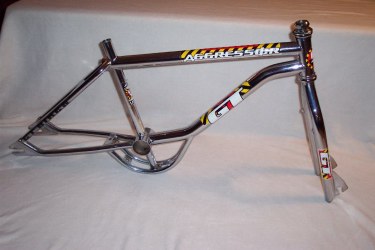
Progression? The bashguard didn't represent progression. It was a mere mutation in the gene pool, like standing platforms or Z-Rims. A BMX appendix. Bashguard bikes were heavy and unwieldly, yet they were still weak enough that your average 13-year-old could destroy one in a summer. When they passed on in the mid-'90s, I don't recall a single rider shedding a tear. Around 1993 I replaced my broken 1991 GT Aggressor with a 1985 Haro Sport and considered it an upgrade.
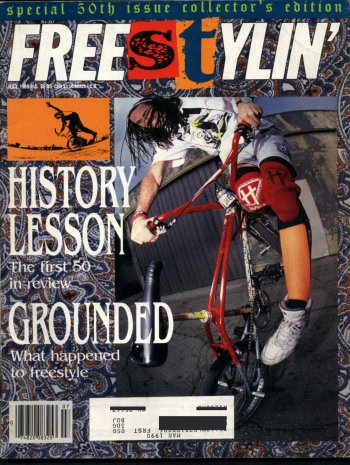
If anything, bashguard bikes represented the Hot Topicification of BMX—big companies finding a way to profit from a legitimate movement. Only riders were slowly waking to the fact that they didn't NEED these companies to tell them what was cool. The time period that followed has been dubbed the "dark days" of BMX, as bike sales dropped precipitously, pro riders were forced to get real jobs, and magazines went out of business. But BMX never died, it just re-focused. Those may have been dark days financially, yes, but they also birthed rider-owned companies like S&M, Hoffman and Standard, not to mention Ride magazine and Props. Dark days? No way. That was the period of enlightenment, as riders realized how much power they really had. What followed was the Renaissance. Bashguard bikes were an end, not a beginning.
Then again, if Mötley Crüe can still sell out gigs, and people are willing to pay $400 for grips that sucked in the '80s, and Knight can produce stuff like this, well, maybe it's fine.
After all, if I've learned anything over the years, it's that there's no accounting for taste.
•••••••••••••••••
I'm sorry, but YouTube embedding being disabled is just plain stupid. That said, I was gonna post this video today no matter what.
Working on something longer for tomorrow (here's a hint), so just some quick hits today, I fear.
•••••••••••••••••••••
The latest entry for "What Does A Real Bike Look Like?," courtesy of the Blue Falcon:
I particularly like the inverted frontload drop stem with high-rise bars and a spacer underneath. Time for a new Fit topload stem? Also please note the visible seatpost, big dirt front tire, metal pedals and dress-unfriendly standover height. BFF!
•••••••••••••••••••••
Hey look, a new Profile color. No way!
Still somewhat surprised that Profile keeps banging out new colors of the Race Cranks without trying a bigger, hollow spindle or a two-piece design or something. While I do respect the "if it ain't (that) broke, don't fix it" mentality, I also think there would be a huge market for a Profile crank that's stronger than the Race but not quite as massively overbuilt as the SS/DJ. American-made, 22mm, 48-spline chromoly cranks? How could they miss?
•••••••••••••••••••••
If you ever wanted to knock off your own Pivotal setup, here's your chance. Or at least you can see how many patents are involved. From an interview Tunney did with Darcy at Macneil. (I would love to know how much revenue the Pivotal patents bring in annually—not that anyone will ever tell me. Bastards.)
•••••••••••••••••••••
Ben Ward at Odyssey sent me this along with my monthly check (kidding!)—that's a gen-you-wine SPRFLS sticker on the bike rack in front of the PDX's own Goods. Holla. (I'm gonna get more made soon, promise.)
•••••••••••••••••••••
Finally, how could something right be so wrong? Don't get me wrong, it's totally awesome that Vans gave Tobias Wicke a signature shoe, especially since they seem to be hard to come by these days (signature shoes for BMXers, not Vans).
Just another generic street/trails bike, right? How about now?
That's right, boys and girls, it's a 22" BMX bike! Yay! That means we now have every size covered in increments of 2, from 10" right up to 26". A reader e-mailed me the link to this blog, and a quick search revealed the Faction Bike Co. website.
The advantage of a 22", best I can tell, is that it's bigger than a 20" but not as big as a 24". According to the UK's only certified BMX and skateboard coach (huh?), the Faction is "a lovely blend with the handling of a 20" and the stability of a 24"." And on Faction's own website it states "the bike is designed to fill the demand for a freestyle-capable bike that is more ergonomically suited to adult-sized riders. The customers for this bike are older BMXrs or MTB riders who want a cross-over bike between freestyle mountain-biking and BMX."
Skateboarders don't have to put up with this crap.
I've spent a lot of time around BMXers, and I've yet to hear anyone say "man, I wish there was a wheel size between 20" and 24"." I've certainly never thought it myself. Will there be a market for a 22"? Probably. I'm sure some guys who quit riding years ago will say, "hey, it's not a little kid's bike, but it's not a cruiser. Perfect!" Blech. What it is, is a novelty. Neither fish nor fowl, as they say. And unless it catches on in some sort of major way, you won't be able to buy aftermarket forks, rims or tires from any company except Faction (not to be confused with the late, lamented BMX magazine). Clever move, that.
(I reserve my right to change my mind if companies like Odyssey and S&M buy in, or Faction assembles a team of super-tall riders—starting with Neil Harrington and Magilla—or if they send me a bike and I really, really like it.)
In a world where every new BMX "innovation" is met at best with praise and at worst with a shrug, there needs to be a voice of dissent. SPRFLS is that voice. Make no mistake—we welcome progress, provided it actually IS progress. You are not the width of your handlebars.
Feel free to e-mail suggestions, corrections, tips or death threats to sprfls@gmail.com
Even more pointless (and sometimes entirely un-BMX-related) twittering at http://twitter.com/SPRFLS and http://twitter.com/russbengtson