Ah, flatland.
Remember when flatland bikes used to be kind of normal? Probably not, unless you're over 25. All the way through the early '90s, "freestyle" bikes were multipurpose. All-around guys like Dennis McCoy, Kevin Jones and Rick Moliterno rode flatland, vert and street on the
same bike. Watch any of the Dorkin' In York videos, and you'll see. Some guys even rode flat with (gasp) a freewheel.
I'm not entirely sure when it all changed. Haro made the Master (an update of their original Freestyler) and the
Sport starting way back in 1984 (the Master being the flat frame, and the Sport being the vert/all-around model), but plenty of guys (including McCoy and
Moliterno) rode everything on their Masters. Heck, I had a Master and I still can't even do a whiplash. Guys who rode for GT just rode the Pro Performer, and later the Pro Freestyle Tour, for everything.
Maybe it started to really change with the introduction of the Standard Shorty back in the mid '90s. That was a seriously small frame compared to, say, an S&M Holmes, but no smaller than an old Master. Then there was the
Morales flatland frame, which was even more specialized. Combine it with Kore (Bob Morales's other company) zero-offset forks and a pair of zero-sweep bars, and you had a bike that was terrific for flatland, but not so great for much of anything else, including just riding around.
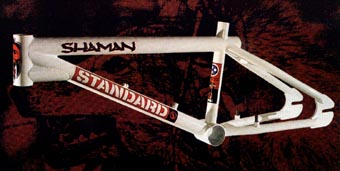
This ushered in even more specialization. Straight up-and-down front ends that felt exactly the same forwards or backwards. Steeper headtube angles. Shorter and shorter rear ends. There were flat/street hybrid frames available (like Bobby Fisher's
Standard Shaman and Andrew Faris's Volume Mid), but most flatland frames were built strictly for spinning and scuffing. You'd have had an easier time trying to ride trails on a beach cruiser or street on a
recumbent.
Things just got weirder from there. Flatland virtually disappeared from mainstream BMX magazines and videos. It became its own subculture, with its own videos and
mailorders and companies. Frames got even weirder as toptubes got lower and downtubes and chainstays got higher. Sometimes the bottom bracket just hung off the bottom of the frame like an afterthought. Short and low frames were built up with super-high seatposts and bars so they were virtual squares. Gearing got lower, cranks got shorter. The only way to get your bike to a spot was to put it in the back of your car. Riding with the crew was more or less out of the question.
Now, we find ourselves in interesting times. Street bikes have gotten lighter and lighter, freecoasters have found their way onto more and more bikes. Guys like Joel Moody have re-introduced flatland moves to the streets. (Nate Hanson was just a few years ahead of his time—and it's funny how people forget that guys like Jay Miron and Dave Osato could pull off entire flatland routines on their 45-pound ramp bikes, but I digress.) Yet flatland continues on as its own entity, and frames and parts keep getting weirder and weirder. Like this one, from KGB, which looks almost exactly like a
mini race frame:

Or this latest incarnation of the Fly Suelo (which used to be such a
normal-looking bike):

Both of those frames remind me an awful lot of this:

Then there are the parts, the zero-sweep bars with super-low crossbars, the plastic pedals (they beat the street companies to it by roughly 20 years), the massive aluminum pegs, and tiny little sprockets which enable one to ride out of anything (and, combined with super-short chainstays means you can get two chains for the price of one). These KGB sprockets are by far my favorites:

Have a nice day.