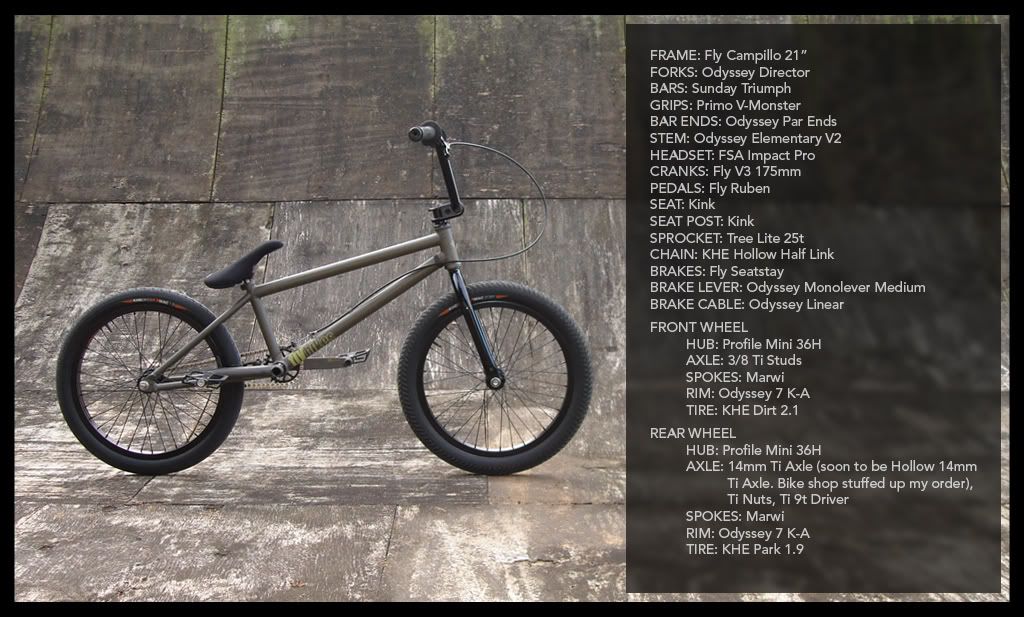
Yes, folding tires with Kevlar beads have been made for road and mountain bikes for years. (As usual, BMX is only a decade or so behind the times.) All sorts of pros run them with minimal problems.
Yes, it's an easy and relatively cheap way to save a fairly substantial amount of weight—rotating weight, even!
But, as stated here on several occasions, I'm not particularly enamored with KHE and their BMX "innovations." (Remember the proprietary Coke-can headtube internal detanglers?) The idea of buying a lighter—and more expensive—tire that would no doubt wear down faster just to save a couple of ounces wasn't really appealing. Not to mention the whole folding thing was entirely inconsequential unless one was embarking on a long road trip or planning on mailing them to people. Who carries extra tires on a regular riding day? There was no way this whole expensive folding tire thing was going to catch on in BMX.
As usual, I was wrong. Laughably so.
They sold like crazy to the gram-conscious (and bike-check obsessed) crowd, and now there are no shortage of companies making (read: putting their logo and tread pattern on) folding tires—Fit, Fly, Animal, We The People, even Revenge Industries. (I envision Sean McKinney unravelling stolen bulletproof vests to harvest the Kevlar for them.) The Kevlar beads alone, according to the late, great Sheldon Brown, save roughly 50 grams—two ounces—per tire. Of course he was talking about road and mountain tires, which are larger in diameter. So lets say it's more like three ounces per pair. That's not too shabby. For example, it's more than you'll save by going from a steel to ti rear axle (according to the Profile website, their solid chromoly 14mm rear axle weighs 8.1 ounces, while a ti one weighs 5.3 ounces).

But according to the ever-reliable Dan's Comp website, the weight savings are actually more substantial than that. A regular old 2.1 Animal GLH tire weighs in at 26.9 ounces, while the identical size GLH Type R is 21.2 ounces. That's 5.7 ounces per tire, almost 3/4 pound for the pair. A 20x2.15 KHE "Park" tire saves you even more weight—it's only 13.4 ounces, four ounces lighter than their "Street" tire. A pair of the big "Park" tires weighs less than a single 20x2.1 GLH. Absurd.
So there's obviously more to this than just Kevlar beads. Thinner sidewalls, lighter casing, different rubber compounds, less rubber overall, crystal meth. BMX tires went straight Star Jones. What's not to like?
Well, how about flats? I hate 'em. Used to hate 'em so much that I would run an old tire with the bead cut off inside another tire. The upside was that you could run over Kerry King and not get a flat. The downside was that my wheels weighed about as much as the ones on a Harley-Davidson. Not that anyone was overly concerned with that sort of thing. Obviously priorities have changed. And while many of the folding tires also offer sturdier lightweight casing to reduce flats, that's not going to help much if you run over an industrial staple. Or, for that matter, if you let your PSI get too low. Folding tires aren't like Primo Walls, which you could safely run down to approximately eight psi. If you're going to go the folding route, invest in a decent floor pump. You'll need to keep that pressure up.
 (By the way, if you couldn't tell, I absolutely love the pillbug product shots that accompany all the folding tire announcements and advertisements. "Our tires roll up 4.6 percent tighter than the competitors!" "Our tires can be shot out of a cannon!")
Price is still a bit of a deterrent as well. Sure, folding tires are only $15 or so more per tire than their conventional brethren. But if you go through tires in a hurry, that adds up quick. The cost per ounce saved will only go up over time. It's up to you to decide whether it's really worth it. If you primarily ride smooth indoor parks, folding tires make perfect sense. If you primarily ride glass-strewn city streets, maybe they're not such a great idea.
As of now, at least you still have a choice. Folding tires haven't totally supplanted "normal" tires. If you want a $35 lightweight tire that can be sent to you in an envelope, you can get those. If you want a $17 unfoldable tire with steel beads and enough tread to endure a summer's worth of skids, you can get those, too. (And you can also get a $22 tire that falls somewhere in the middle—non-folding, but lighter than a "conventional" tire.) If you want to pick your tire by weight, you can do that (if so, I recommend you also pick up one of these). If you want to go by price, that's fine, too. Which means the tire market is healthier than the frame market—imagine if you could still choose between, say, a Tierra and an Angel of Death. Choice, in this case, appears to be a good thing.
But I can also still think that folding tires in BMX—at least in their current incarnation—are more trouble than they're worth for the average rider. Like too many things these days, folding tires are great if you're a sponsored pro who gets them by the case. Not so much if you have to dip into the rent money every time you need a new one.